Exploring Fresnel & Fraunhofer Diffraction
When early physicists like Huygens, Young, and Fresnel studied light, they noticed something unusual: Light didn't only travel straight — it bent around edges and created unexpected shadow patterns.
But these patterns changed drastically depending on how close the obstacle and screen were. Scientists realized that one mathematical model couldn't explain both situations.
Fresnel Number: 0.61
Fraunhofer Regime (F < 1)
The key parameter that determines the diffraction regime is the Fresnel Number:
\( F = \frac{a^2}{L\lambda} \)
Where \(a\) is the aperture size, \(L\) is the distance to the screen, and \(\lambda\) is the wavelength of light.
Near-field patterns where wavefronts are curved and patterns are irregular.
Occurs when source, slit, or screen are close to each other.
Far-field patterns where wavefronts are flat and patterns are stable.
Occurs when light source and screen are at large distances.
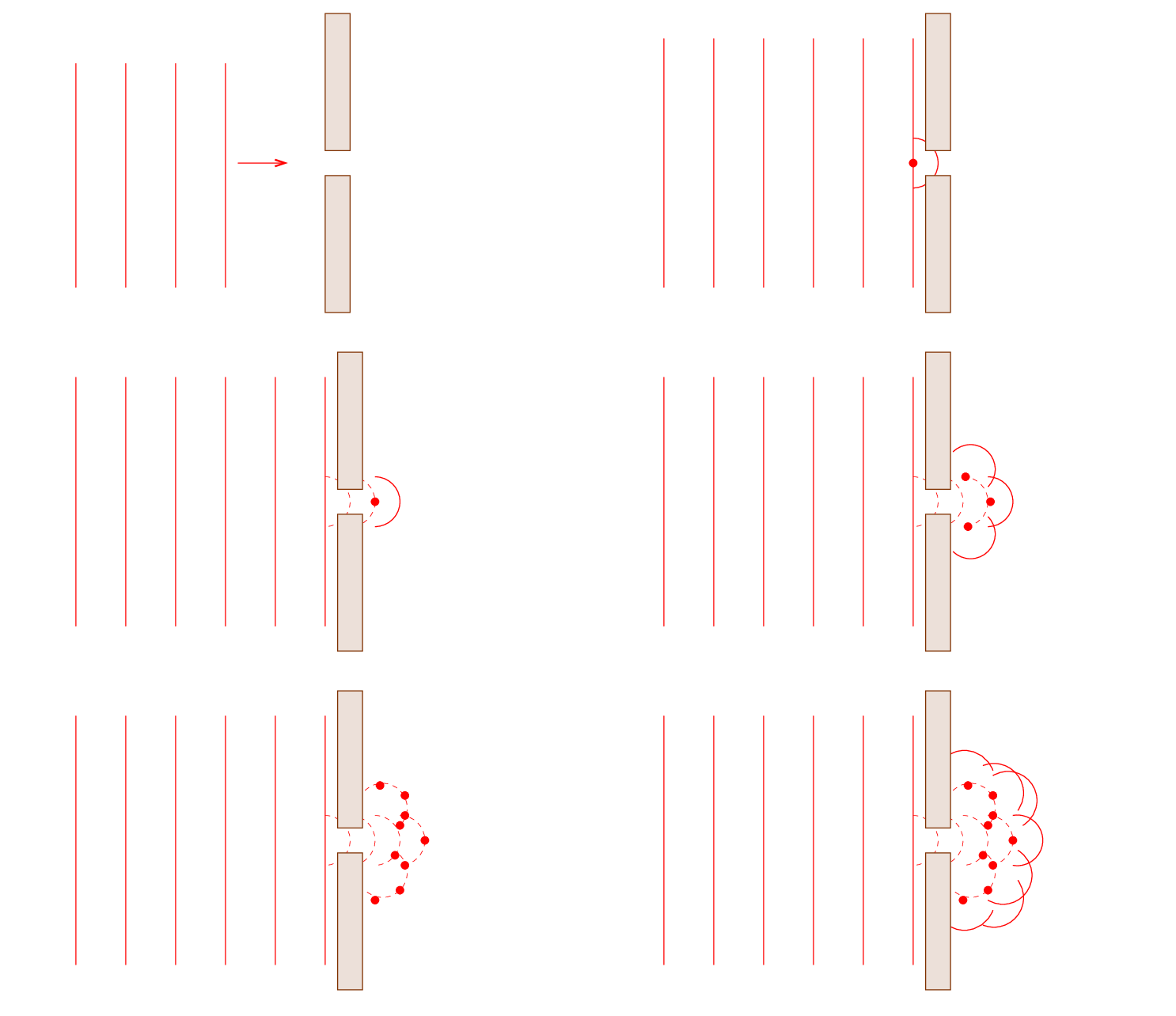
Proposed by Augustin-Jean Fresnel while proving the wave nature of light, Fresnel diffraction occurs when the source, slit, or screen are close to each other.
Wavefronts reaching the slit are curved, not flat.
Diffraction pattern changes with distance and appears irregular.
Light is still reorganizing its wavefronts.
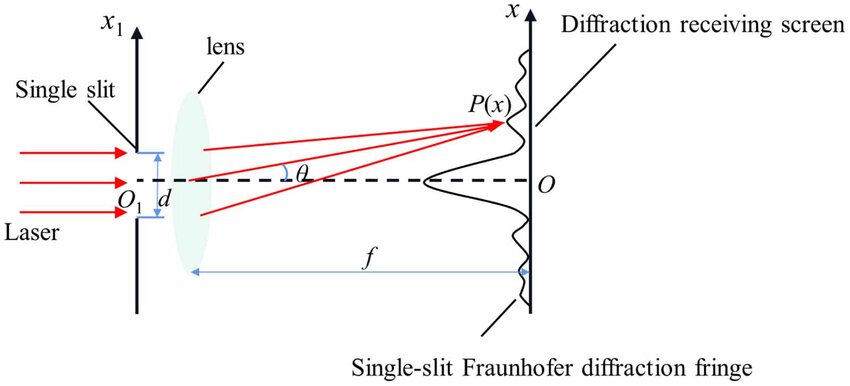
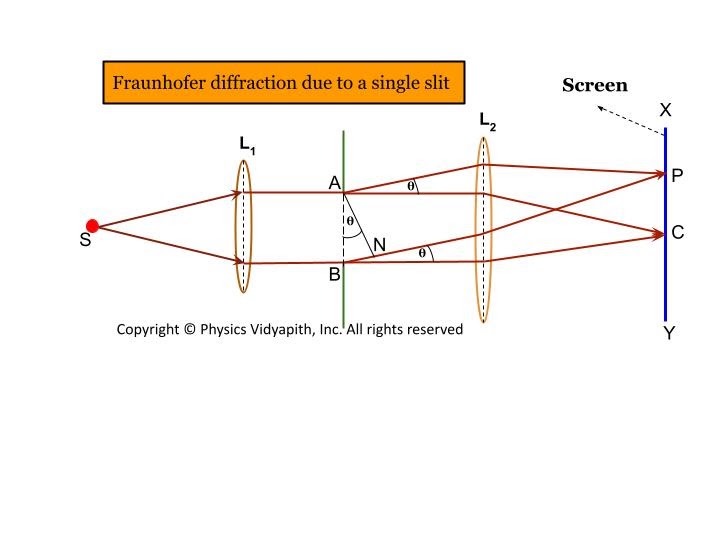
Developed by Joseph von Fraunhofer, who studied light using prisms and diffraction gratings, Fraunhofer diffraction occurs when the light source and screen are at a large distance, or lenses convert the waves into parallel rays.
Incoming wavefronts become plane (flat), simplifying calculations.
Produces a clean, stable, symmetric diffraction pattern.
Light has traveled far enough that wave curvature disappears.