I. Presentation Scope and Objective
This presentation explores the physical phenomenon of polarization in light—a core concept in Wave Optics. It defines the fundamental distinction between polarized and unpolarized electromagnetic waves, structured across four thematic sections: definitions, properties, comparisons, and practical applications.
1. Defining the States of Light
Unpolarized Light
Light waves that vibrate randomly in all possible directions perpendicular to the direction of propagation. Emitted by common sources such as sunlight, incandescent bulbs, candle flames, and most standard LEDs.
Polarized Light
Light in which the electric field oscillations are confined to a single plane perpendicular to the direction of propagation. This behavior is possible because light is a transverse electromagnetic wave.
Polarization of Light
2. Key Properties and Classification
Unpolarized Light: Composed of short, randomly oriented wave trains with equal distribution across all polarization states. When passed through an ideal linear polarizer, it transmits exactly 50% of its original intensity.
Polarized Light is classified by the trajectory of its electric field vector:
- Linear Polarization: Electric field oscillates in one fixed direction.
- Circular Polarization: Electric field rotates uniformly in a circular path.
- Elliptical Polarization: Electric field traces an elliptical path—the general case.
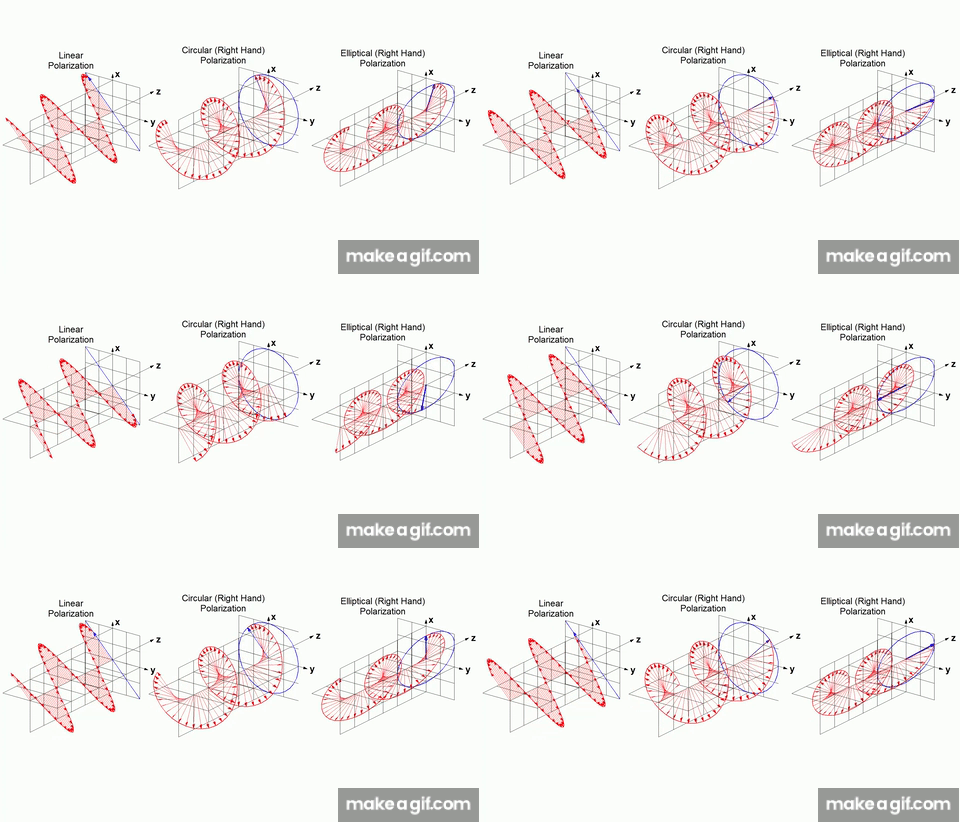
Terminology: The Plane of Vibration is where the electric field oscillates; the Plane of Polarization is perpendicular to it (a historical convention still used in optics).
3. Comparison and Generation
Unpolarized Light
Random, uncorrelated orientations
Polarized Light
Ordered, coherent orientation
Methods of Generating Polarized Light
- Transmission: Polaroid filters transmit only one polarization axis.
- Reflection: Partial polarization occurs at Brewster's angle on dielectric surfaces.
- Birefringence: Crystals like calcite split light into two polarized components.
4. Practical Applications
From polarized sunglasses that reduce glare, to LCD screens, optical microscopy, fiber-optic communications, and stress analysis in engineering materials—polarization underpins modern optical technology.